Amazon Early Reviewer Program vs Vine: Which Is Right for Your Products?
Put up a listing with no reviews and see what happens. Honestly, nothing. People scroll right past it, the algorithm unprioritised it, and good product photos don’t fix the trust problem As an Amzon ads verified partner It’s something the RootAMZ team deals with constantly new sellers stuck in that exact spot, wondering why nothing’s moving.
A Quick Recap: What Were These Programs?
Amazon Early Reviewer Program
This one had a pretty simple setup ran from 2016 to 2021. Sellers paid a flat $60 per SKU, Amazon reached out to people who’d already bought the product, and offered them a small gift card (usually a dollar or two) to share their opinion. No pressure, no script. Just a prompt to someone who’d already used it.
Did it work? Well enough, yeah. Then Amazon pulled it in 2021 without any real notice or replacement. At RootAMZ we still get questions about it, people who’ve read old blog posts or seen it mentioned somewhere. Short answer: gone. No version of it is still active.
Amazon Vine
Vine is a different thing entirely. Amazon keeps a vetted pool of reviewers called Vine Voices people they’ve identified as thorough, consistent, and unbiased based on their review history. Brand-registered sellers can submit a product, hand over up to 30 free units, and Amazon sorts out the matching. The reviewer gets the product, uses it, and writes what they actually think. Every review ends up with a green Vine badge, so buyers know upfront it came from a free unit.
How Amazon Vine Works Today
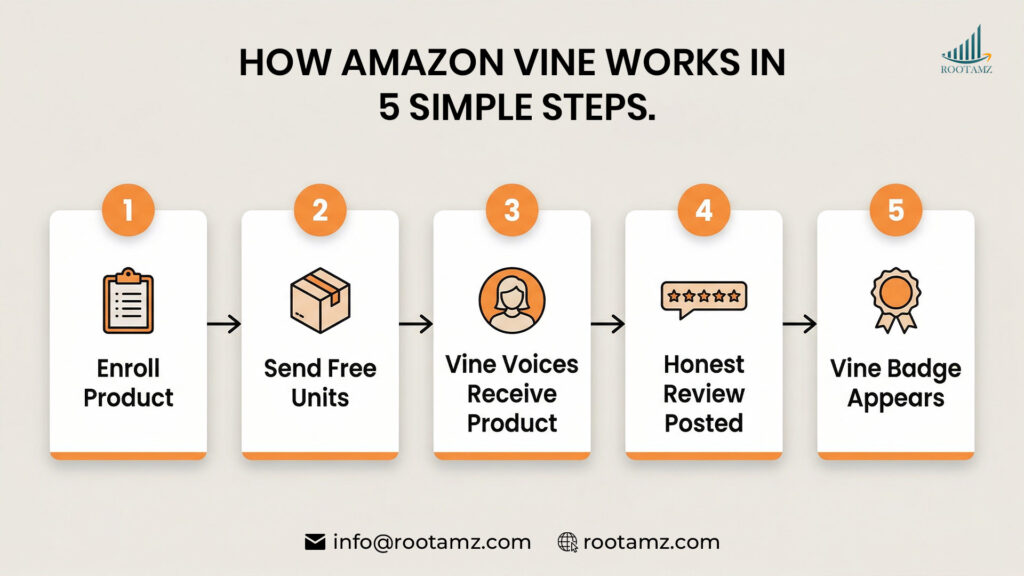
If you’re brand-registered, the actual mechanics aren’t complicated. In this Amazon Vine enrolment guide, the process starts by enrolling an ASIN that has fewer than 30 reviews, then shipping up to 30 units to Amazon they handle the matching and distribution. Vine Voices don’t get a brief or a target outcome; they receive the product, use it however they see fit, and write what they genuinely think.
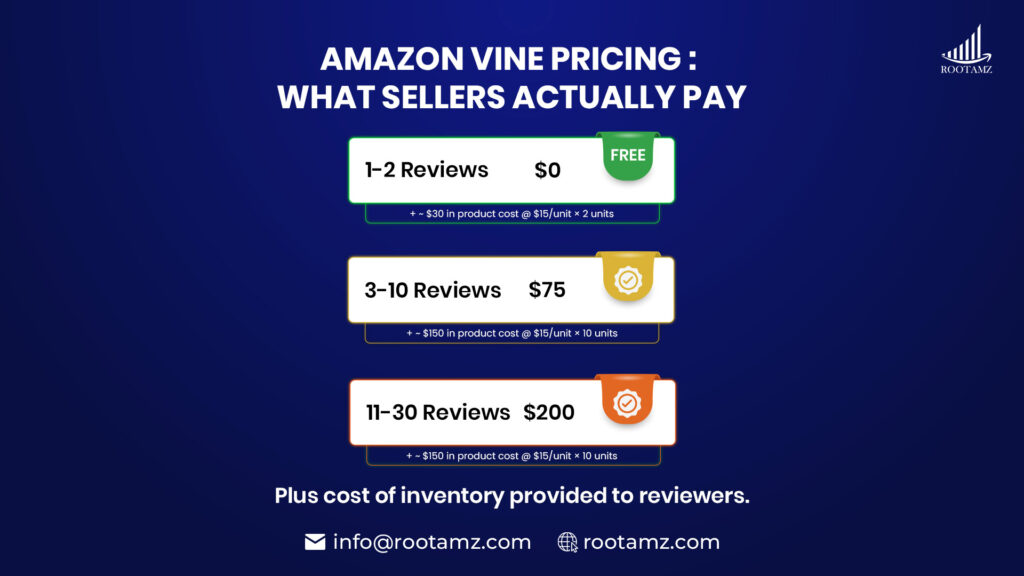
Pricing shifted in late 2023. It now scales depending on how many reviews the product actually gets:
- $0 for products that receive 1-2 Vine reviews
- $75 for products that receive 3-10 Vine reviews
- $200 for products that receive 11-30 Vine reviews
And that’s before the units. Say you ship 20 at $30 each that’s already $600 out the door before any program fee gets added. The RootAMZ team goes through the actual math with clients before anything gets submitted. If the margins aren’t there, Vine just isn’t the right move, however good the product is.
When Vine Makes Sense And When It Doesn’t
Vine works well when:
The product can genuinely hold up to someone poking at it properly, you’re going into a category where review volume actually shifts where you show up in search, and the unit cost of giving 15-30 away won’t blow the margin.
Vine may not be worth it when:
There are still rough spots in the product that detailed feedback would surface, the numbers don’t work financially, or the category is niche enough that the Vine reviewer pool won’t really reflect who you’re actually selling to.
What a lot of sellers don’t expect: Vine reviewers aren’t quick and surface-level. They dig in. They write properly. When the product is solid, that depth is genuinely valuable. When it’s not quite there yet, that same thoroughness can leave a mark on a new listing that’s hard to recover from. RootAMZ tells every client the same thing get the listing sorted first. Title, bullets, images, price. Then go to Vine.
The Bigger Picture: Reviews Are Just One Piece
The RootAmz team raises this with almost every client at some point: getting reviews isn’t really the goal. Selling is. A listing with 50 reviews and copy that doesn’t actually say anything useful will consistently lose to a page with 20 reviews and a title and bullet structure that answers what buyers are actually asking. The copy, images, and keywords are doing the heavy lifting reviews just reinforce it.
Vine speeds up the review side of things. But it can only do so much if it’s pointing at a listing that isn’t ready. RootAMZ works on the whole setup listing builds, Amazon A+ Content, keyword research, PPC, Brand Store, launch strategy, competitor analysis. Both sides together.
If Vine’s in the plan, RootAMZ can make sure the page is genuinely ready before those reviews start landing. Too many solid products get an unfair start simply because the listing wasn’t doing its job. That’s a fixable problem, but easier to fix before you enrol, not after.
Vine vs. Early Reviewer: Quick Comparison
| Feature | Early Reviewer (Discontinued) | Amazon Vine (Active) |
| Status | Ended 2021 | Active |
| Eligibility | < 5 reviews, any seller | Brand Registry required |
| Max Reviews | Up to 5 | Up to 30 |
| Cost | $60 flat fee / SKU | $0-$200 + unit cost |
| Product Given Free? | No – buyers who purchased | Yes – xw1 units sent to reviewers |
| Review Guarantee? | No | No |
| Transparency | Standard review | “Vine” badge shown |
Final Thoughts
Early Reviewer is gone. Vine is what’s left, and for the right product with the right listing behind it, it does what it’s supposed to. But it’s not a patch for a weak page or an unfinished product. Never has been.
Get the listing right first that’s the RootAmz view on it, and it hasn’t changed. Head to rootamz.com to see what RootAmz actually covers: listing builds, Amazon PPC Management, A+ Content, launch strategy, and the rest of what it takes to build something that grows on Amazon properly.
✅ Is Amazon Vine Worth It for Your Product? Get a Clear Answer Now
FAQ’s
Do I need to be Brand Registered to use Amazon Vine?
Yeah, Brand Registry is required. Worth doing on its own merits though you get A+ Content, Brand Analytics, a proper storefront the RootAMZ team walks sellers through pretty often.
Can RootAmz help with listing optimisation before I enrol in Vine?
That's essentially the core of what RootAMZ does. Vine reviews only move the needle if the listing they're landing on is doing its job.
Are Vine reviews always positive?
Vine Voices are selected precisely because they review honestly and in detail not because they're easy on products.
Is Amazon Vine worth it over just waiting for organic reviews?
Organic means follow-up emails, repeat buyers, time. Vine costs real money though, especially once you add up the unit cost and the program fee.