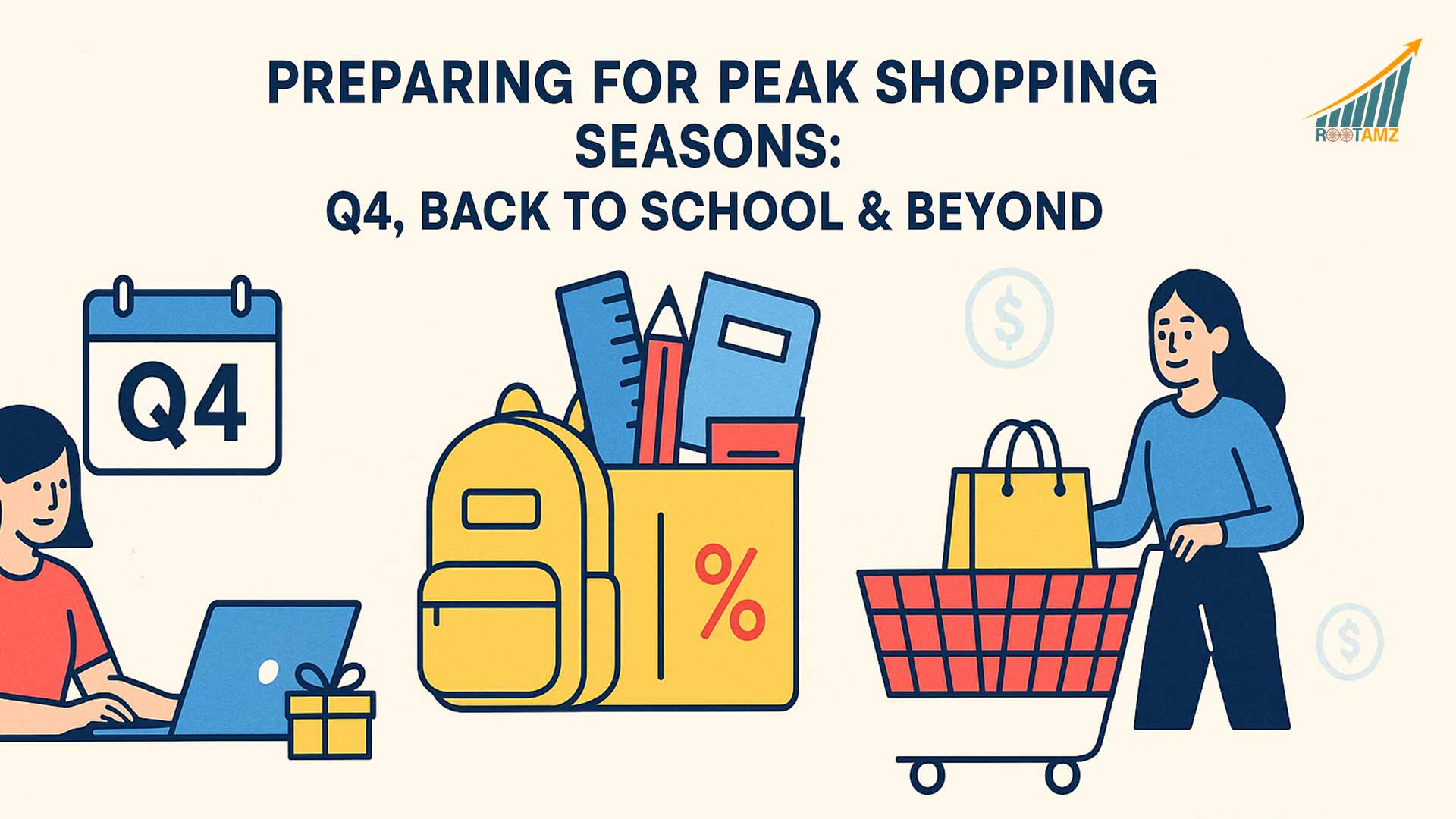
Preparing For Peak Shopping Seasons: Q4, Back to School & Beyond

Your Competitors Are Already Preparing While You’re Still Catching Up
Every year, the same story repeats: peak shopping seasons arrive, demand explodes, & unprepared sellers watch helplessly as stockouts, advertising inefficiencies, & operational chaos destroy what should be their most profitable months.
The brutal reality? Q4 holiday shopping, Back-to-School, Prime Day & other peak seasons represent 40-60% of annual revenue for most marketplace sellers. Yet, many approach these critical periods reactively rather than strategically, leaving massive revenue on the table.
What’s at Stake?
Missing peak season preparation means stockouts during high-demand periods, wasted advertising budgets competing against better-prepared competitors, eroded pricing power due to desperation discounting, & operational disasters that generate negative reviews precisely when visibility peaks.
The Opportunity
Sellers who master peak season preparation don’t just survive; they dominate categories, capture disproportionate market share, & generate profits that sustain their businesses through slower months.
In this guide, we’ll reveal RootAMZ’s proven strategies for preparing for peak shopping seasons from Q4 holiday madness to Back-to-School, Prime Day, & every major shopping event throughout the year. More importantly, we’ll show you how to implement preparation systems that make peak seasons predictable, profitable, & scalable year after year.
1. Understanding Peak Shopping Season Calendar
Before diving into preparation tactics, you must understand the annual rhythm of eCommerce demand to plan inventory, advertising, & operations effectively.
Major Peak Seasons:
Q1 (January-March):
- New Year resolutions drive fitness & self-improvement products.
- Valentine’s Day (February 14): Gifts, jewelry, chocolates.
Q2 (April-June):
- Mother’s Day (May): Gifts & beauty products.
- Father’s Day (June): Tools & electronics.
- Graduation season: Gifts & professional attire.
Q3 (July-September):
- Prime Day (July): Amazon’s biggest promotional event.
- Back-to-School (late July-early September): Supplies & electronics.
Q4 (October-December):
- Halloween: Costumes & decorations.
- Black Friday/Cyber Monday: Massive sales event.
- Holiday Shopping: Gifts across all categories.
Different product categories experience unique seasonal patterns that require customised preparation. For instance, toys & games see 65-70% of annual sales in Q4, while electronics peak during both Q4 & Back-to-School.
2. The 90-Day Preparation Timeline
Success requires preparation beginning 90 days before demand peaks. Last-minute scrambling guarantees suboptimal results.
90 Days Out: Strategic Planning Phase
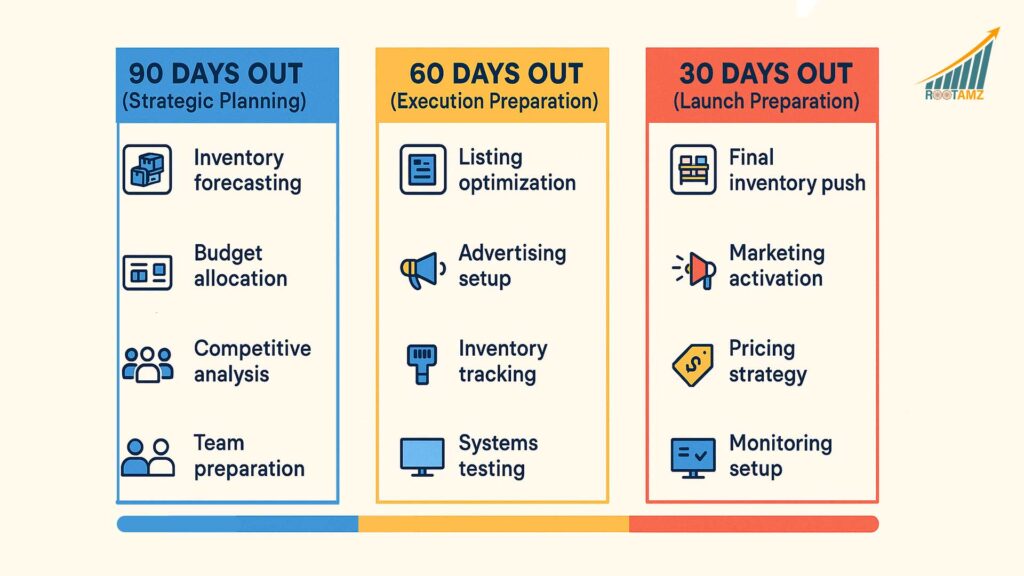
Inventory Forecasting:
- Analyse previous year’s sales data.
- Calculate required inventory (Peak daily sales × season duration × 1.5 safety factor).
- Place orders ensuring arrival 30 days before the season starts.
Budget Allocation:
- Increase advertising budgets 2-3x normal spending for peak periods.
- Reserve capital for inventory purchases (typically 40-60% of quarterly budget).
Competitive Analysis:
- Review competitor strategies from previous peak seasons.
- Analyse pricing patterns & promotional timing.
Team Preparation:
- Hire seasonal customer service support.
- Train team on peak season protocols.
60 Days Out: Execution Preparation
Listing optimisation:
- Refresh all product images & update titles emphasizing gift-giving angles.
- Advertising Campaign Setup:
- Build seasonal advertising campaigns 30-45 days before launch.
- Inventory Arrival Confirmation:
- Confirm supplier production completion & track shipping progress.
30 Days Out: Launch Preparation
- Final Inventory Push:
- Verify all inventory arrived & checked into FBA/warehouses.
- Marketing Activation:
- Launch seasonal advertising campaigns at 50% target spend.
- Pricing Strategy:
- Finalise pricing for peak season & configure dynamic pricing rules.
3. Inventory Management: The Foundation of Peak Season Success
Nothing destroys peak season profitability faster than stockouts or excessive inventory.
Demand Forecasting Methodology
- Historical Analysis: Calculate previous peak season performance.
- Growth Adjustment: Apply year-over-year growth rates.
Safety Stock Calculation
Build an inventory buffer to protect against demand surges & supply chain delays. For example, if normal daily sales are 20 units & peak season multiplier is 3x, ensure sufficient stock levels to avoid stockouts.
4. Advertising Strategy for Peak Season Dominance

Peak seasons bring 3-5x normal advertising competition. Unprepared sellers waste budgets while strategic advertisers capture disproportionate returns.
Budget Scaling Approach
- Gradually ramp up advertising budgets leading into peak periods.
Seasonal Keyword Strategy
Focus on gift-oriented keywords & urgency keywords to capture traffic effectively. Promotional mechanics like Lightning Deals & coupons can significantly enhance visibility & sales.
5. Operational Excellence During Peak Chaos
Even with perfect inventory & advertising, operational systems must handle 3-5x normal volume without degrading customer experience.
Customer Service Scaling
Prepare for increased inquiries & ensure your team can respond promptly. Hire additional staff & streamline processes for returns & exchanges.
6. Post-Season Strategy: Capitalising on Momentum
Peak season doesn’t end when demand drops strategic post-season actions determine whether momentum compounds or evaporates.
Inventory Liquidation
Implement clearance pricing to move excess stock & avoid long-term storage fees.
Performance Analysis
Review key metrics such as total season revenue, stockout incidents, & advertising ROI to inform future strategies.
7. Category-Specific Peak Season Strategies
Different product categories require unique preparation for peak season success. For instance, toys & games should focus heavily on Q4, while apparel must emphasise back-to-school & holiday gifting.
8. Why RootAMZ Ensures Peak Season Success
Most sellers approach peak seasons reactively. RootAMZ implements systematic preparation eliminating guesswork & maximising profitability. We create customised timelines, analyse historical data, & provide advertising strategies & operational scaling to ensure your success.
Real Results: RootAMZ Peak Season Success
Case Study: Toy Brand Q4 Transformation
Challenge: Prior stockouts cost 180Kinlostsales.Solution:Implementeda90−dayplan,resultinginzerostockoutsand420K in revenue.
Case Study: Apparel Brand Back-to-School Dominance
Challenge: Competing in a saturated market.
Solution: Early inventory orders & targeted strategies led to $290K in revenue.
Conclusion:
Peak shopping seasons represent critical moments for marketplace sellers. Success requires strategic preparation, operational excellence, & continuous improvement. Are you ready to dominate your next peak shopping season? Let RootAMZ guide you to success!
✅Ready to dominate your next peak shopping season?
FAQ’s
How much inventory should I order for peak season?
Calculate: (Average daily sales during peak × season duration × safety factor 1.3-1.5). Example: If you sell 20 units daily normally, peak season might be 60 units/day for 60 days = 3,600 units base. With 1.5 safety factor = 5,400 units total. Account for growth (20-30% year-over-year), new marketplace expansion, & promotional surges. Under-ordering causes stockouts & lost revenue; over-ordering creates clearance burdens & storage fees.
Should I increase my advertising budget during peak seasons, & by how much?
Yes, significantly. Recommended scaling: 60 days before (1.2x normal), 30 days before (1.8x), peak period start (2.5-3x), peak week like Black Friday (4-5x). Competition intensifies during peak seasons—maintaining normal budgets means losing visibility precisely when demand peaks. Budget increases should correlate with inventory levels (don't overspend if you'll stock out). RootAMZ provides budget scaling recommendations ensuring optimal ROAS throughout peak periods.
How do I avoid stockouts during peak season without ending up with too much leftover inventory?
Precise demand forecasting using multi-year historical data, conservative safety stock (1.3-1.5x forecast, not 2-3x), monitoring sales velocity weekly during peak season, & having contingency plans for emergency reorders if demand exceeds forecasts. Post-season clearance pricing structured in tiers (15%, 25%, 35%+) over 4-6 weeks prevents long-term storage fees while maximising revenue recovery. RootAMZ's inventory intelligence system balances these competing priorities.
What's the biggest mistake sellers make during peak shopping seasons?
Waiting too long to prepare. Most sellers don't begin serious planning until 30-45 days before peak season—by then, inventory ordering is too late, advertising positions are established by competitors, & operational hiring becomes rushed. This reactive approach guarantees suboptimal results. The second biggest mistake: failing to analyse post-season performance & document learnings, causing repeated mistakes year after year. RootAMZ's systematic approach prevents both errors through proactive planning & comprehensive post-season analysis.